Weekly Pool Maintenance Checklist for Beginners
Quick Summary
Weekly pool maintenance is a short, repeatable routine: skim the surface, empty the baskets, brush and vacuum, test the water, adjust chemicals one at a time, and check the equipment. Done in about an hour, it catches small problems before they become expensive ones.
- Skim the surface, empty the skimmer and pump baskets, then brush and vacuum each week.
- Test free chlorine, pH and total alkalinity, and write the three numbers in a log.
- Adjust total alkalinity first, pH second, and free chlorine last, one product at a time.
- Test free chlorine every two to three days in summer because heat and swimmers burn it off quickly.
- Never mix chemicals in one container and always add product to water, not water to product.
Table of Contents
- Why a Weekly Pool Routine Matters in Frisco and the DFW Area
- Your Weekly Pool Maintenance Checklist at a Glance
- Essential Pool Cleaning Tools for Beginners
- Skimming, Brushing and Vacuuming: The Physical Cleaning Steps
- How to Balance Pool Chemicals Safely
- Pool Maintenance Cost in Frisco, TX: What Drives the Price
- Troubleshooting Common Weekly Problems
- Booking Your First Professional Pool Check with Aqua Bright
- Frequently Asked Questions
Why a Weekly Pool Routine Matters in Frisco and the DFW Area
Last Updated: November 21, 2026
A weekly pool maintenance routine is the single habit that keeps a backyard pool clear, safe and inexpensive to run. For a deeper periodic service beyond weekly care, see what professional acid washing involves.
A weekly routine is essentially a set of small, repeatable tasks: skim the surface, empty the baskets, brush and vacuum, test the water, and check the equipment.
Spring brings pollen and tree debris, summer brings heavy use and high sun that burns off chlorine, and fall sends leaves into the water.
Your Weekly Pool Maintenance Checklist at a Glance
Copy this list onto your phone or print it and tape it inside the pump room door. Each line includes what you need, how to do it, and how you know the task is finished, so a first-time owner can work top to bottom without guessing.
- Skim the surface (5-10 minutes). Tool: telescoping pole with a fine-mesh skimmer net. Work from the far side toward the skimmer, pushing leaves, pollen and insects into the skimmer throat. Done when the surface is clear and the net comes up with little more than a few stray bits.
- Empty the skimmer and pump baskets (5 minutes). Turn the pump off first. Lift the skimmer lid, pull the basket, dump debris, and rinse. Repeat at the pump basket, checking the lid O-ring for grit or cracks. Done when both baskets are empty and the lids seat without resistance.
- Brush the walls, steps and waterline (10-15 minutes). Tool: nylon brush on the pole (stiff bristles only for concrete; vinyl and plaster need nylon). Brush top-down so loosened material falls to the floor. Done when the waterline tile or plaster shows no visible film and the steps feel slick-free.
- Vacuum the floor (10-20 minutes). Manual vacuum head and hose, or an automatic cleaner. Move in slow, overlapping passes with the pump running so debris reaches the filter. Done when you can see the main drain and no leaf litter trails the vacuum head.
- Test free chlorine, pH and total alkalinity (5 minutes). Use a liquid reagent kit rather than strips for pH and alkalinity. Sample about arm’s length below the surface, away from return jets. Done when you have written the three numbers down, a log makes week-to-week trends obvious.
- Adjust chemicals as needed, one product at a time (10-15 minutes). Add with the pump running, add product to water (not water to product), and never mix two chemicals in one container. Done when the dose is in, the pump has run at least a few hours, and you have retested.
- Check water level and equipment (5 minutes). Confirm the water sits near the middle of the skimmer mouth, glance at the filter pressure gauge against its clean baseline, and look over the pump, valves and visible plumbing for drips or unusual noise. Done when the level is right, pressure is within a few psi of baseline, and there are no new leaks.
Frisco seasonal adjustments to the same checklist:
- Spring (pollen and storm season): Skim and empty baskets twice a week, and expect the pump basket to fill fast after a front blows through. Pollen consumes chlorine, so test free chlorine midweek as well until the yellow dust stops.
- Summer (high heat and heavy use): Sun and bather load burn off chlorine quickly, so test free chlorine every two to three days rather than once a week, and shock after a heavy swim day or a storm. Watch the water level, evaporation in North Texas summer can drop it below the skimmer mouth in a week.
- Fall (leaf drop): Empty baskets more often than once a week and skim before leaves waterlog and sink. Vacuuming frequency goes up; brushing can stay weekly.
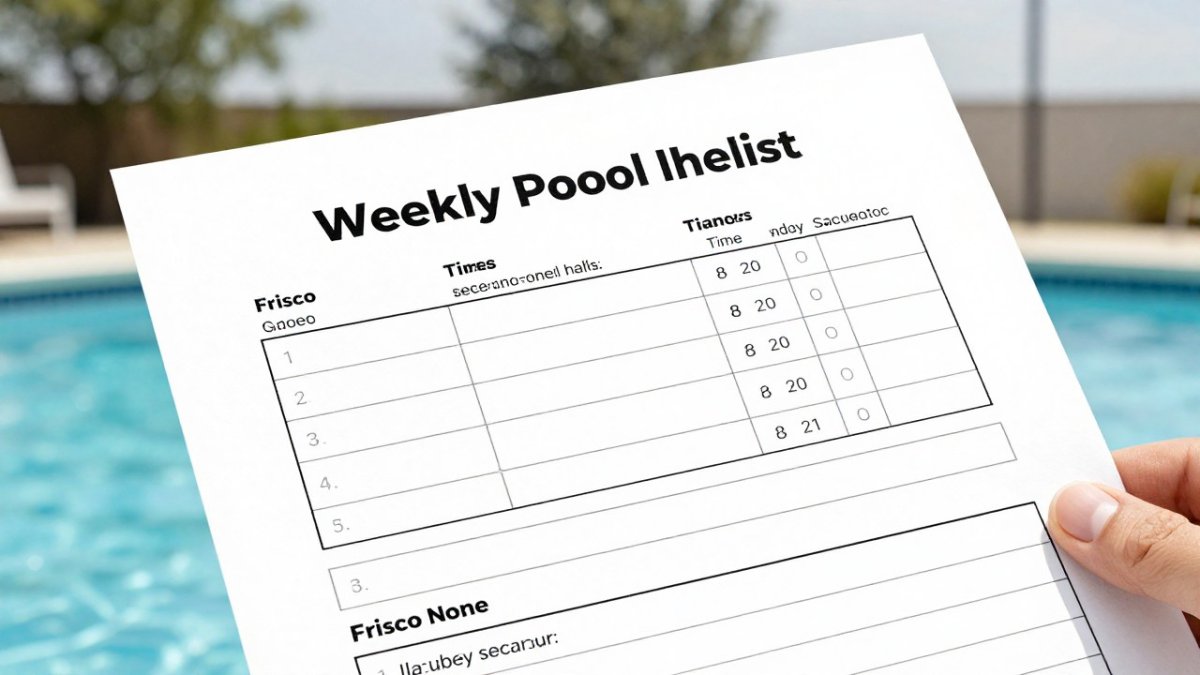
The core weekly tasks, with the time each one takes, are summarised below.
| Step | What to do | Time |
|---|---|---|
| Skim the surface | Use a fine-mesh net from the far side | 5-10 minutes |
| Empty baskets | Turn pump off, empty skimmer and pump baskets | 5 minutes |
| Brush walls and steps | Brush top-down with the right bristles | 10-15 minutes |
| Vacuum the floor | Slow, overlapping passes with pump running | 10-20 minutes |
| Test chemistry | Test free chlorine, pH and total alkalinity | 5 minutes |
| Adjust chemicals | Add one product at a time, then retest | 10-15 minutes |
| Check level and equipment | Confirm water level, pressure and leaks | 5 minutes |
Time
Essential Pool Cleaning Tools for Beginners
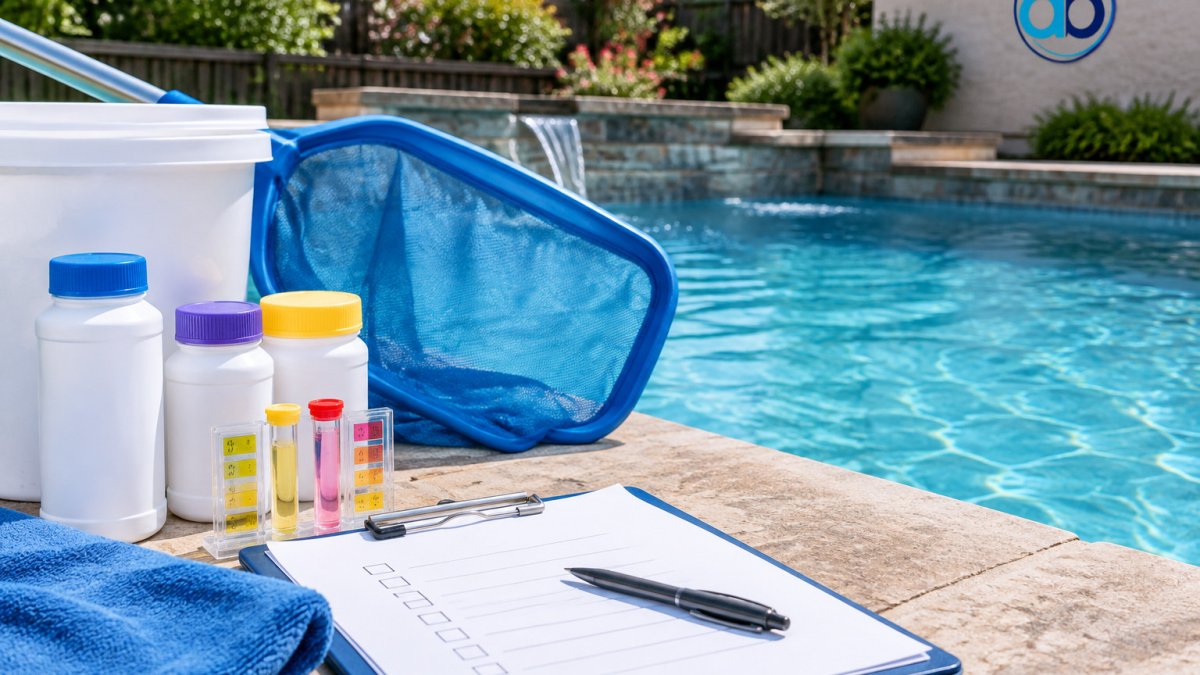
You do not need a large collection of equipment to maintain a residential pool. A basic kit usually includes:
- Telescoping pole: Lets you reach the whole pool from the deck. Choose one long enough to reach the deepest point without stretching.
- Skimmer net: A fine-mesh net for leaves and bugs on the surface.
- Pool brush: Use a nylon brush for vinyl or plaster and a stiffer one for concrete. Using the wrong bristles can scratch the finish.
Keep a dedicated bucket for chemical containers and store all products out of reach of children and pets.
Skimming, Brushing and Vacuuming: The Physical Cleaning Steps
Physical cleaning does more than look good. Debris left on the bottom consumes chlorine and feeds algae, so brushing and vacuuming directly protect your water chemistry.
Start with the surface. Skim from the far side toward you, pushing leaves and pollen to the steps or the skimmer opening. Next, brush the walls and steps from the top down, so anything you loosen falls to the floor for vacuuming.
Emptying the Skimmer and Pump Baskets
Baskets are the most overlooked step in weekly care. When a skimmer or pump basket fills, water flow drops, the filter works harder and the pump can overheat. Turn the pump off before opening any basket, remove the lid, lift out the debris and rinse the basket. Check the O-ring on the lid and look for cracks in the housing while you have it open.
How to Balance Pool Chemicals Safely
Balanced water protects your equipment, keeps swimmers comfortable and makes sanitizer work efficiently. The three readings that matter most each week are free chlorine, pH and total alkalinity. The beginner mistake is adding a little of everything at once; the fix is to test, calculate one dose, add it, circulate, and retest before touching anything else.
Turning a Test Reading Into a Dose
Every chemical adjustment starts with your pool volume in gallons.
Use the dosing chart on the product label, which is written in ounces per 10,000 gallons to move a reading by a set amount.
Work in this order each week:
- Total alkalinity first. It buffers pH, so adjusting it last means re-fixing pH. Target 80-120 ppm.
- pH second. Target 7.4-7.6. Once alkalinity is right, pH usually holds.
- Free chlorine last. Keep it within the range your test kit and the CDC’s healthy-swimming guidance call for.
Make one change at a time, run the pump at least four hours, and retest before the next adjustment. Large single doses are harder to correct than two small ones.
Safe Handling, Storage and Mixing
- Add product to water, not water to product. Pour slowly at the deep end or through the skimmer only if the label says so, away from your face and with the pump running.
- Never mix chemicals in one container. Calcium hypochlorite and acid react violently and can release toxic chlorine gas. Add them at different times, ideally hours apart.
- Store separately and dry. Keep chlorine and acid on separate shelves, lids tight, out of sunlight and away from children and pets (the CDC). Never store chemicals in the pump room where fumes can corrode equipment.
Watch out: Never add acid and chlorine to the pool at the same time, and never pour water into a chemical container, the heat and splash risk is real. If you are unsure of a dose, add less and retest rather than guessing high.
CDC healthy swimming guidance on pool chemical safety
Pool Maintenance Cost in Frisco, TX: What Drives the Price
Weekly maintenance costs depend on pool size, equipment type, how much chemical the water needs and whether you do the work yourself or hire a service. Because equipment type can affect weekly service needs, solar pool heater maintenance is another factor to consider when estimating the work involved.
Doing the work yourself mainly costs your time and the chemicals and tools you buy. Hiring a service shifts that cost to a regular fee but adds professional testing and an equipment check on each visit.
Troubleshooting Common Weekly Problems
- Cloudy water: Usually low filtration time, high pH or an imbalance in calcium or alkalinity. Check the filter and retest before adding anything.
- Green water: Algae growth, often from low free chlorine. Brush the walls and floor, then shock the pool and keep the pump running. Clear water also depends on the filter, so see why pool filter cleaning matters for clear water.
- Persistent debris on the bottom: Check pump run time and filter cleanliness before assuming the cleaner is the problem.
If problems keep returning, or the equipment makes unusual noises or leaks, a professional inspection is the fastest fix.
Booking Your First Professional Pool Check with Aqua Bright
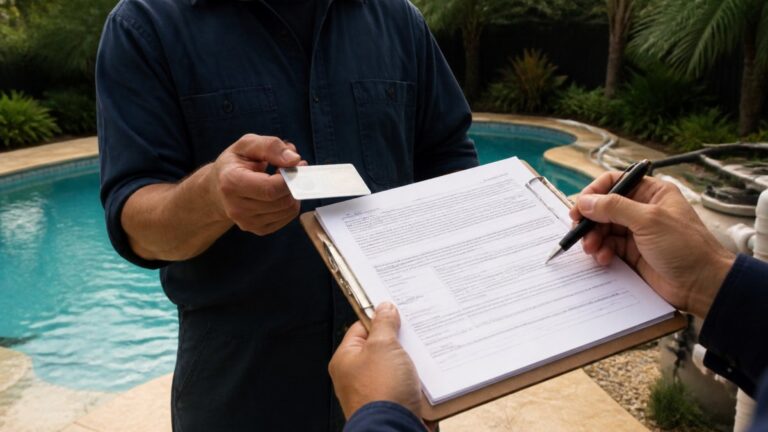
If you are new to pool ownership, a professional check is a useful first step. Our professionally trained technicians can review your chemistry, equipment and routine together. Aqua Bright Pool Service has operated since 2006 with a public storefront office. Contact us to get started and find out what a weekly routine looks like for your pool.
Frequently Asked Questions
What are the basic steps for weekly pool maintenance?
A weekly routine covers five tasks: skim the surface, empty the skimmer and pump baskets, brush the walls, steps and floor, vacuum the bottom, and test and balance the water. Run the pump long enough to circulate the full volume of water each day, and check the pressure gauge on the filter. Doing these tasks in the same order each week keeps the routine quick and makes it easier to notice changes, such as a drop in water level or a rising filter pressure reading.
How often should I test my pool water in North Texas?
Test your pool water at least once a week, and more often during the hot summer months or after heavy rain, a pool party or a big storm. Hot North Texas weather burns off chlorine quickly, so checking free chlorine, pH and total alkalinity regularly prevents algae and cloudy water. Keep a written log of each reading so you can spot trends, such as pH creeping upward over several weeks.
How do I know if my pool water is balanced?
Balanced water usually means pH between 7.4 and 7.6, total alkalinity between 80 and 120 ppm, and free chlorine within the range recommended for your sanitizer type. Water that is balanced should look clear, feel comfortable on the skin and not cause staining or scaling on tile and equipment. If readings are off, adjust one parameter at a time and retest after the pump has circulated the water for several hours.
What chemicals are essential for weekly pool care?
Most beginner routines rely on a chlorine or other sanitizer, a pH adjuster (increaser or decreaser), an alkalinity adjuster and, occasionally, a shock treatment and algaecide. Store chemicals in their original labeled containers, keep them out of reach of children and pets, and never mix products together in the same bucket. Follow the label directions for dosing, and add chemicals to water rather than water to chemicals when diluting.
Can I maintain my pool myself or should I hire a professional in Frisco?
Many homeowners handle the weekly skimming, brushing and basic testing themselves, and a clear checklist makes that manageable. Professional service becomes valuable for chemical balancing that keeps failing, equipment problems such as pump, filter or salt generator issues, and periodic deep cleaning. Aqua Bright Pool Service offers professionally trained technicians for routine maintenance, and state-licensed technicians for repairs. Contact the company directly for current pricing, which depends on pool size, service frequency and the work required.
What is the most important part of weekly pool maintenance?
Water chemistry is the most important part of weekly maintenance because sanitizer and balance control whether the water is safe and clear. Physical cleaning matters too, but a pool with clean-looking water and unbalanced chemistry can still harbor bacteria and algae. Test the water every week, record the results and correct problems early, before they turn into green water or equipment damage.