
Why Is My Pool Water Cloudy? 7 Causes & Fixes
Table of Contents
- Common Causes of Cloudy Pool Water
- Diagnostic Decision Tree: Match Your Symptoms to the Fix
- Test Pool Water Chemistry: Target Ranges and Testing Sequence
- Pool Water Cloudy but Chemicals Are Balanced? Check These 4 Things
- Cloudy Pool Water After Shocking: Why It Happens and What to Do
- Pool Filter Troubleshooting for Cloudy Water: Sand, DE, and Cartridge
- How Long Does It Take to Clear a Cloudy Pool?
- When to Call a Professional Pool Service
- Frequently Asked Questions
Last Updated: October 15, 2026
Common Causes of Cloudy Pool Water
Cloudy pool water is almost always a chemistry or filtration problem, not a mystery.
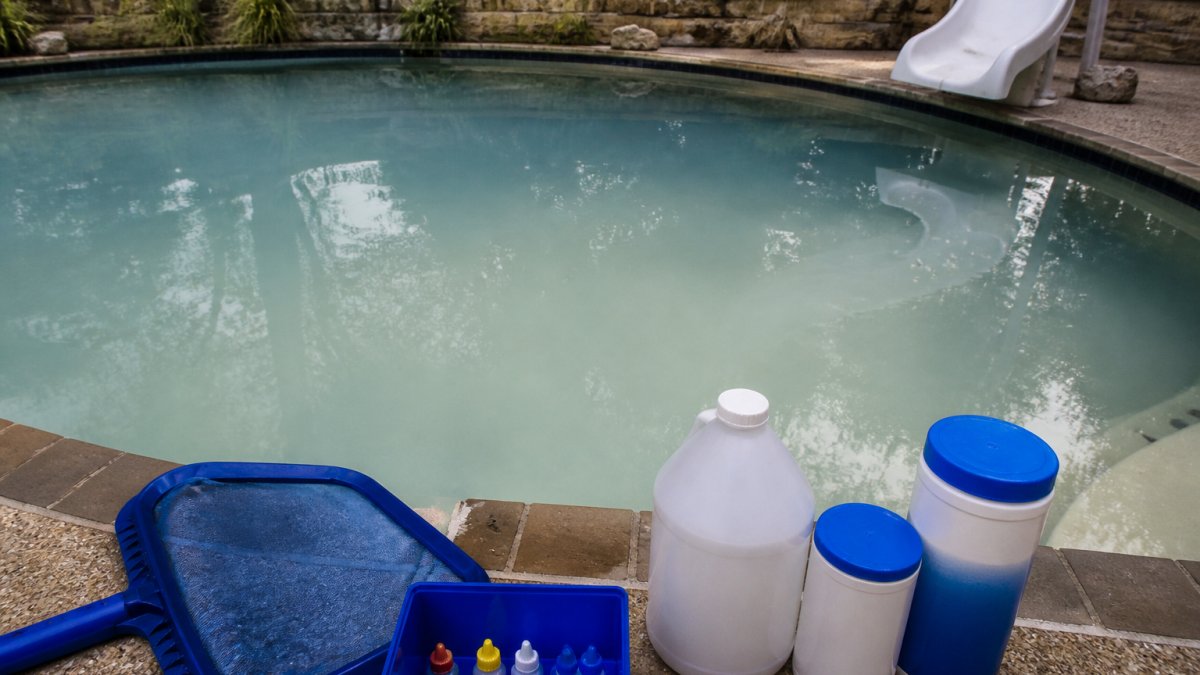
Cloudy water means tiny particles are floating in your pool. They are too small for the filter to catch right away. Clear water is the goal, and getting there starts with knowing the cause.
Chemical Imbalance
Chemical imbalance is the top cause of cloudy water. When pH, alkalinity, or sanitizer levels drift, particles stop dissolving and stay suspended.
Watch these levels:
- pH too high: particles fall out of solution and turn the water milky
- Low free chlorine: algae and bacteria bloom, clouding the water
- High alkalinity or calcium: scale forms and clouds the pool
Fix the chemistry first. Everything else depends on it.
Filtration Failure
A clogged or worn filter cannot clear suspended particles. If your filter pressure is high or the media is old, the water stays cloudy no matter how many chemicals you add.
Check the filter before you shock the pool. A dirty sand, DE, or cartridge filter is a common missed cause.
Environmental and Bather Load
Heavy rain, pollen, and lots of swimmers all add debris and oils. These overwhelm the sanitizer and the filter at the same time.
After a storm or a party, expect cloudiness. Test the water and run the pump longer to recover.
Diagnostic Decision Tree: Match Your Symptoms to the Fix
Most guides hand you a list of causes and tell you to start adding products. That is backwards. Cloudy water has four distinct signatures, chemical imbalance, suspended particles, an algae bloom, and a filtration failure, and each one needs a different first move. Adding clarifier to an algae bloom, or shocking a pool with a torn DE grid, wastes money and keeps the water cloudy.
Work through the tree below in order. Stop at the first branch that matches what you see and what your test kit reads.
Step 1: Test Before You Touch Anything
Pull a water sample from elbow depth, away from return jets. Run free chlorine, pH, total alkalinity, calcium hardness, and cyanuric acid. Write the numbers down. Every branch below depends on them.
Step 2: Branch on the Test Result
If free chlorine is below 1 ppm and the water has a green or yellow tint: this is an algae bloom, not a chemistry drift.
If pH is above 7.8 or total alkalinity is above 120 ppm and the water is milky white with no tint: this is a chemical imbalance.
If the filter gauge reads 8-10 psi above its clean baseline: this is a filtration failure. Backwash or clean the media before you do anything else.
Step 3: Distinguish Suspended Particles From a Failing Filter
Run the pump continuously for 24 hours and recheck the water. If clarity improves but does not fully clear, the filter is working but undersized for the particle load, add a clarifier to bind the fine particles into filterable clumps. If clarity does not change at all, the filter is bypassing or the media is channeled. See the filter troubleshooting section below.
Step 4: Recheck After Every Action
Retest free chlorine and pH after each adjustment. Cloudy water that does not respond to two rounds of correct treatment is a mechanical problem, not a chemical one. Stop adding products and inspect the filter, pump, and circulation.
Test first, branch on the result, and only then add a product. The single most common mistake is treating cloudy water as one problem when it is four.
Test Pool Water Chemistry: Target Ranges and Testing Sequence
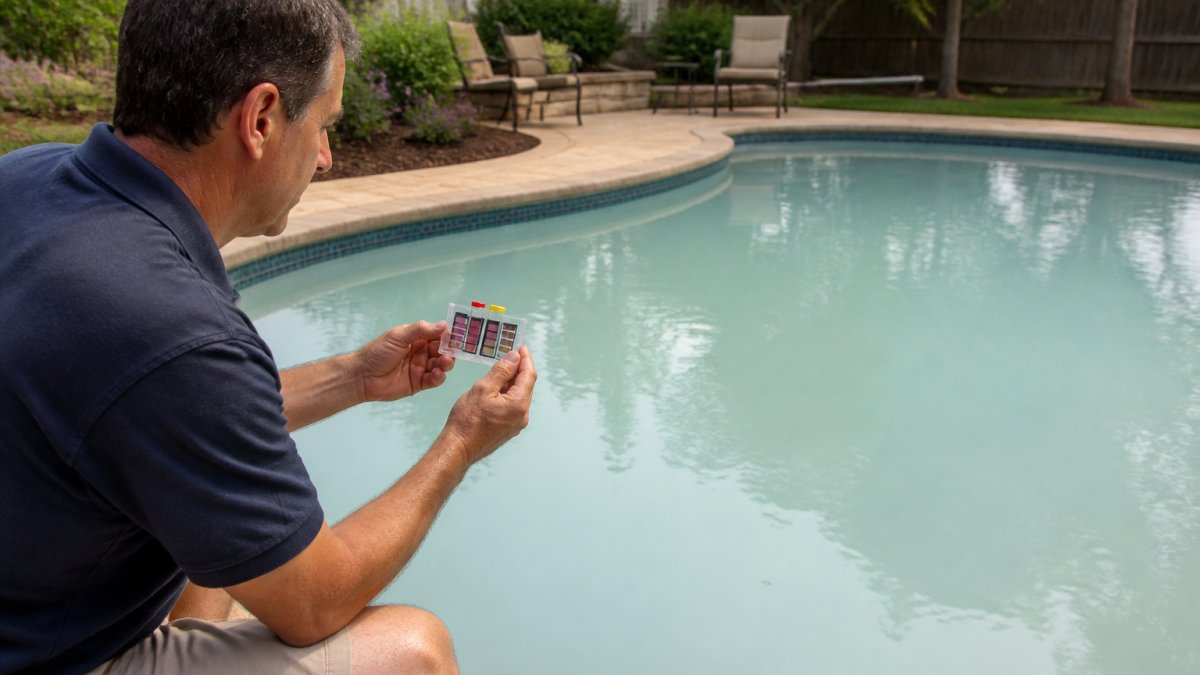
Testing is the first step for any cloudy pool. A good test kit tells you which levels are off so you fix the right problem.
Follow this sequence:
- Free chlorine: keep it at 1-3 ppm for daily use
- pH: target 7.4-7.6
- Total alkalinity: aim for 80-120 ppm
- Calcium hardness: keep it at 200-400 ppm
- Cyanuric acid: hold it at 30-50 ppm
Test free chlorine and pH first. They drive most cloudiness. Then check alkalinity and the rest.
Retest after every treatment. Wait at least a few hours before you retest chlorine.
Test in the morning before the sun burns off chlorine. You get a truer free chlorine reading, and you catch problems before they grow.
Pool Water Cloudy but Chemicals Are Balanced? Check These 4 Things
If your pool water is cloudy but chemicals are balanced, the problem is mechanical, not chemical. The filter, the pump, or the circulation is failing to clear particles the water already has.
Here are the four things to check:
- Filter pressure and media condition
- Circulation dead spots
- Pump runtime
- Debris on the pool floor
Most balanced-but-cloudy pools trace back to a filter that needs cleaning or a pump that runs too little.
Filter Pressure and Media Condition
Filter pressure tells you when the filter is clogged. Note the clean pressure after a backwash. When it rises 8-10 psi above that, it is time to clean.
Old media loses its ability to trap fine particles. Sand lasts about 5-7 years. DE grids and cartridges wear out sooner with heavy use.
Circulation Dead Spots and Pump Runtime
Poor circulation leaves dead spots where particles settle and cloud the water. Check that return jets push water across the whole pool.
Run the pump long enough to turn over the full volume of water at least once a day. In hot weather, run it longer. Short runtime is a quiet cause of cloudy water.
Cloudy Pool Water After Shocking: Why It Happens and What to Do
Cloudy water after shocking is not a sign you did something wrong. It is the visible result of the shock doing its job. Understanding why it happens tells you whether to wait, act, or investigate.
Why Shock Turns Water Cloudy
Shock, whether calcium hypochlorite, sodium dichloroisocyanurate, or liquid chlorine, raises free chlorine fast enough to oxidize algae, bacteria, sweat, sunscreen, and other organics. Oxidation breaks those compounds apart, and the dead cell walls and oxidized particles are too fine for most filters to catch immediately.
A second mechanism matters if you used a calcium-based shock. Calcium hypochlorite adds calcium hardness to the water.
What to Do, in Order
- Run the filter 24 hours straight. Do not cycle it. Continuous turnover is what removes the suspended particles.
- Brush the walls, floor, and steps. Dead algae settles and re-clouds the water if you leave it on the surface.
- Retest free chlorine before you swim. Wait until free chlorine drops to 3 ppm or below and combined chlorine reads 0.5 ppm or less. Swimming at shock-level chlorine irritates skin and eyes and degrades swimwear.
- Add a clarifier only if clarity has not improved after 24 hours. Clarifiers bind fine particles into larger clumps the filter can catch. They do not replace filtration.
- Do not add flocculant at the same time as clarifier. They work against each other.
How Long It Should Take
Most post-shock cloudiness clears in 24-48 hours with continuous filtration. If the water is still cloudy at 48 hours, check three things before adding anything else:
- Filter pressure. If it has risen 8-10 psi above the clean baseline, the filter is loaded with dead organics and needs backwashing or cleaning.
- Cyanuric acid level. If stabilizer is above 50 ppm, your shock was partially neutralized and the algae may not be fully dead. Retest and consider a second shock.
- Pump runtime. If the pump is running fewer than one full turnover per day, the particles are not reaching the filter fast enough.
If all three check out and the water is still cloudy at 72 hours, the problem is not the shock. It is the filter, the circulation, or a chemistry issue the shock masked.
Do not shock again just because the water is still cloudy. Repeated shocking without fixing the underlying cause raises cyanuric acid or calcium hardness, which makes the next round of cloudiness worse.
Pool Filter Troubleshooting for Cloudy Water: Sand, DE, and Cartridge
Pool filter troubleshooting for cloudy water starts with knowing your filter type. Each type has its own failure points and its own fix.
Sand Filter Fixes
Backwash when pressure rises 8-10 psi. If backwashing does not help, the sand may be channeled or old. Replace the sand every 5-7 years.
DE Filter Fixes
DE filters catch the finest particles. Backwash, then add fresh DE powder. Check the grids for tears, because a torn grid lets DE into the pool and clouds it.
Cartridge Filter Fixes
Pull the cartridge and hose it clean. Soak it in filter cleaner to strip oils. Replace cartridges when the pleats stay dirty after cleaning.
How Long Does It Take to Clear a Cloudy Pool?
A cloudy pool usually clears in 24-72 hours once you fix the cause. Fast results come from correct chemistry, a clean filter, and enough pump runtime.
Timeline by cause:
- Chemical imbalance: 24-48 hours after balancing
- Algae bloom: 2-3 days after shock and brush
- Clogged filter: hours after cleaning
- Post-shock cloudiness: 24-48 hours
If the water is still cloudy after 72 hours, the filter or circulation needs a closer look.
When to Call a Professional Pool Service
Call a professional when the water stays cloudy after you have tested, balanced, and cleaned the filter. Persistent cloudiness can point to a failing pump, a torn DE grid, or a chemistry issue that needs a full test.
At Aqua Bright Pool Service, our state-licensed technicians handle everything from chemical balancing to filter repairs. We have served pool owners since 2006 with a randomized audit process that keeps our work consistent. If you want clear water without the guesswork, we can help.
Frequently Asked Questions
Why is my pool cloudy even though the chemicals are balanced?
Balanced chemistry does not guarantee clear water. Cloudy pool water with balanced chemicals usually points to a mechanical problem: a clogged or channeled filter, a pump running too few hours, dead spots in circulation, or fine debris the filter cannot catch. Start by checking filter pressure against its clean baseline. If pressure is 8-10 PSI above normal, backwash or clean the filter. Then confirm the pump runs at least 8-12 hours daily in summer. If both check out, a clarifier can help bind particles so the filter captures them.
Why does my pool water turn cloudy after shocking?
Cloudy pool water after shocking is often temporary and expected. Shock oxidizes contaminants like sweat, sunscreen, and algae, and the dead particles turn the water milky until the filter removes them. Run the pump continuously for 24-48 hours after shocking and watch filter pressure. If cloudiness lasts beyond 48 hours, the shock may have been insufficient for your chlorine demand, the filter may be clogged, or pH and alkalinity may be out of range. Retest and adjust before adding more shock.
How long does it take to clear a cloudy pool?
Most mild cases clear in 24-48 hours with continuous filtration and correct chemistry. Moderate cloudiness from algae or heavy bather load may take 2-3 days. Severe cases, especially with a failing filter, can take up to a week. Three factors control the timeline: how far off your chemistry is, how well the filter captures suspended particles, and how many hours per day the pump runs. Test daily, keep free chlorine in range, and clean the filter whenever pressure rises 8-10 PSI above baseline.
Is it safe to swim in a slightly cloudy pool?
The CDC advises against swimming when you cannot clearly see the bottom of the pool, especially at the deep end. Cloudy water can hide debris, sharp objects, and a swimmer in distress, and it may signal low sanitizer or algae growth. If cloudiness is mild and free chlorine is at least 1-3 ppm with pH between 7.2 and 7.8, a brief swim carries low risk, but the safest move is to fix the water first. Clear water is a safety feature, not just an aesthetic one.
Cloudy water is frustrating, but it is almost always fixable with the right steps. If testing and cleaning do not clear your pool, the problem may be equipment that needs expert repair. Aqua Bright Pool Service offers comprehensive maintenance, intricate repairs, and full-scale renovations backed by state-licensed technicians. Contact us to get started and enjoy crystal-clear water again.