
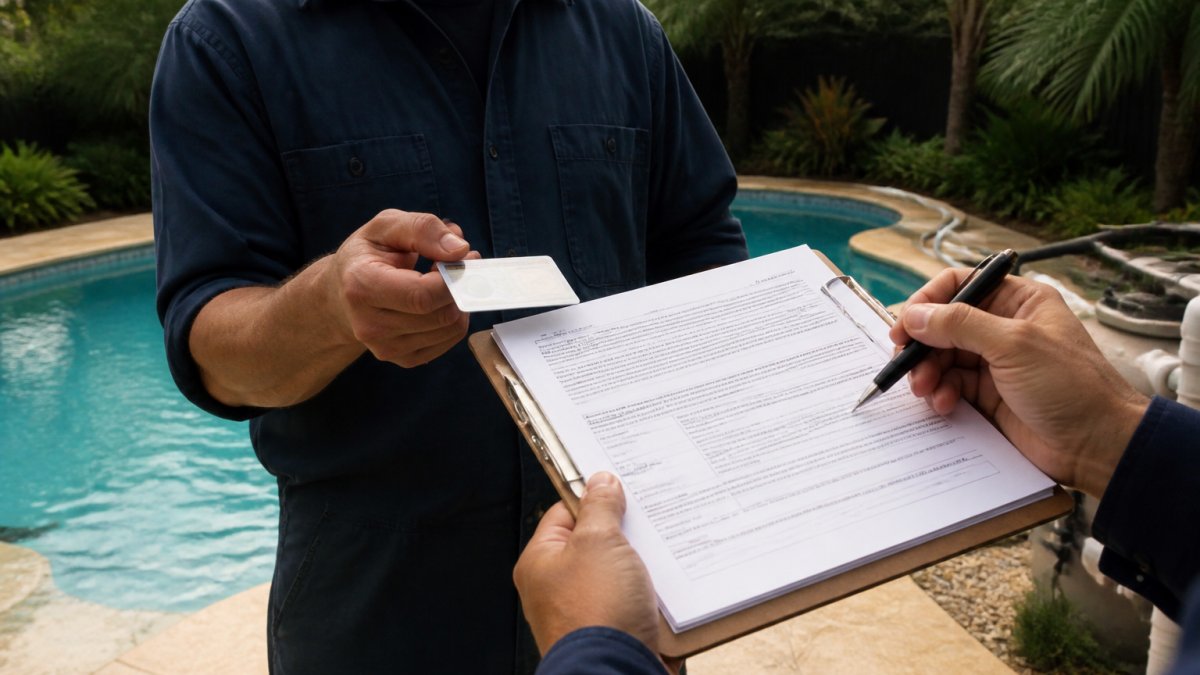
How to Verify a Pool Technician License: 7 Steps
Table of Contents
- Why Verifying a Pool Technician License Matters
- Pool Technician License Lookup: Step-by-Step
- Certified Pool Operator Certification: What It Is and Isn’t
- How to Verify a Pool Contractor Is Insured
- Red Flags: Forged Certificates and Fake Credentials
- Questions to Ask a Pool Service Company Before Hiring
- What to Do If a Credential Doesn’t Check Out
- Frequently Asked Questions
Last Updated: October 16, 2026
Why Verifying a Pool Technician License Matters
A pool technician license is a state-issued credential that confirms a service professional has met required training and competency standards for pool and spa work. At Aqua Bright Pool Service, we encourage every homeowner to check credentials before hiring anyone.
The stakes are real. A technician who mishandles water treatment can leave your pool with unsafe chemical levels. Someone without proper training may misdiagnose a pump or salt generator and sell you equipment you do not need. Unlicensed operators also carry no accountability if something goes wrong.
Here is the core problem: most homeowners never ask. They see a branded truck and a friendly face and assume everything checks out.
The good news? Verifying a credential takes about ten minutes. This guide walks you through the exact steps, including what to do when your state does not license individual technicians at all.
Pool Technician License Lookup: Step-by-Step
Start by answering one question: does your state license pool technicians as individuals, or does it license the contracting business instead? The answer determines which agency and which lookup tool you use. Most states assign pool and spa work to a Department of Consumer Protection, a health department, or a dedicated contractor licensing board, but the split varies enough that guessing wastes time.
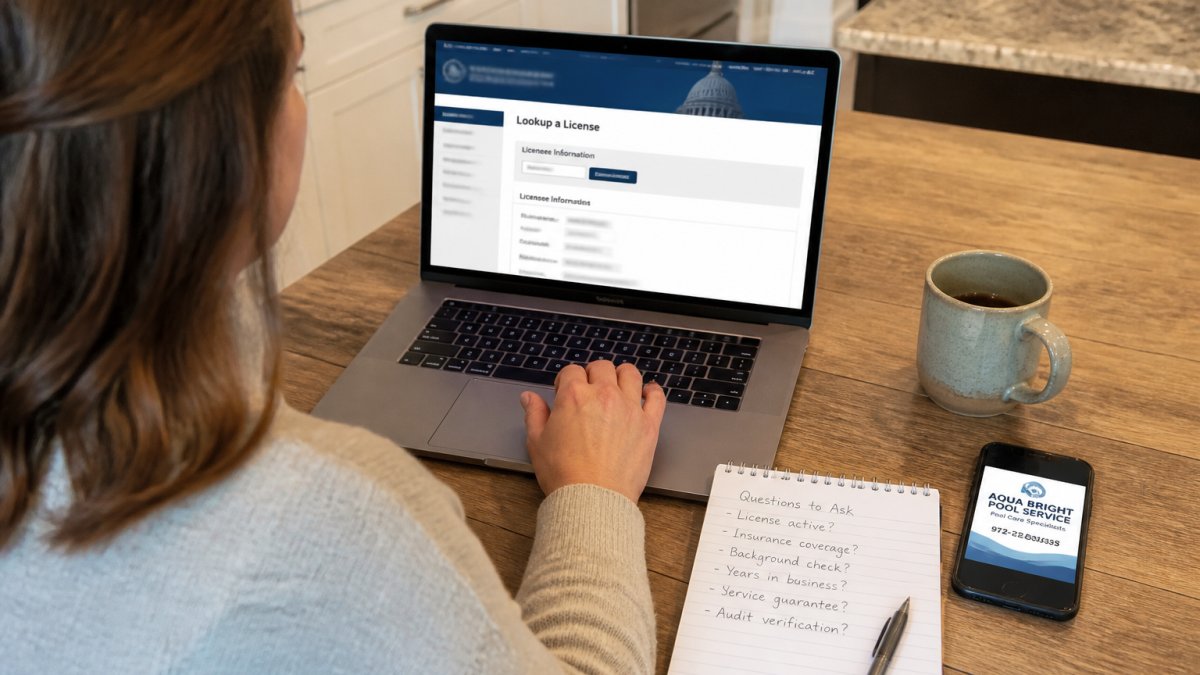
The state licensing directory links to every state’s licensing authority and is the fastest way to find the right agency. From there, work through this sequence:
- Identify the regulator. Search the agency site for terms like “pool,” “spa,” “swimming pool contractor,” or “residential pool service.” If nothing matches, the state likely regulates the business rather than the individual technician.
- Find the lookup portal. Most agencies host a searchable license database. Some route through a shared state portal (often labeled “license search” or “verify a license”).
- Search by the right field. Try the license number first, then the individual’s legal name, then the business name. Company names and license names frequently differ, so search all three.
- Confirm the record matches the person at your door. Check that the name, license type, and service category line up with the work being quoted.
- Capture the record. Save a screenshot or PDF showing the status, expiration date, and license number, along with the date you checked.
Reading License Records and Status Labels
Status labels are not interchangeable, and the difference between them is where most homeowners get tripped up:
- Active, the credential is valid today and the holder may legally perform the covered work.
- Expired, the credential lapsed. The holder cannot legally work under it until it is reinstated.
- Suspended, the credential is temporarily invalid, usually pending discipline or a compliance issue.
- Revoked, the credential has been permanently withdrawn by the agency.
- Restricted or probationary, the holder may work only under specific conditions, such as supervision or a limited scope.
Many records also list a service category (for example, repair versus construction) and a complaint or disciplinary history. Read those entries carefully: a license can be active while still carrying an open complaint.
If the lookup returns no record at all, do not assume the technician is unlicensed. Common causes include a misspelled name, a maiden or trade name, a license held by the business rather than the individual, or a record that has not yet been posted after a recent renewal. Try alternate spellings and the business name before drawing a conclusion. If the record still cannot be found, call the agency directly and ask them to search by license number.
Write down the license number, the agency name, the status, and the date you checked. If a dispute arises later, that note is far more useful than a memory of a website you visited once.
When No Statewide Pool Technician License Exists
Some states do not license individual pool technicians at all. In those places, licensing applies to the contracting business instead, and the individual technician may carry only voluntary credentials. This is where credential verification gets tricky, and most guides skip it entirely.
If no statewide technician license exists, confirm qualifications through these channels instead:
- Certified Pool Operator (CPO) certification from the Pool & Hot Tub Alliance, a training credential, not a government license.
- Business registration with your state’s Secretary of State or equivalent filing office.
- Local permits for pool construction or repair work, which are often issued at the city or county level.
- Proof of insurance carried by the company, verified directly with the agent.
When a state does not license technicians, ask for the CPO certification number directly. You can confirm CPO status through the Pool & Hot Tub Alliance certification lookup, which maintains a searchable record of certified operators.
Certified Pool Operator Certification: What It Is and Isn’t
Certified Pool Operator certification is a training credential, not a government license. The CPO program covers water chemistry, chemical dosing, equipment diagnostics, and safety standards, and it is widely respected in the pool and spa industry. But the distinction matters when you are trying to verify someone’s right to work.
Here is the practical difference:
- A license is issued by a government agency, carries a legal requirement to hold it, and can be suspended or revoked by that agency.
- A certification is issued by a private organization, is voluntary in most jurisdictions, and reflects completion of training and an exam.
A CPO certificate does not replace a state license where one is required. It also does not expire the same way a license does; CPO holders must complete continuing education units (CEUs) to stay current.
How to Verify a CPO Credential
Verification follows the same logic as a license lookup, but the issuing body is a private organization rather than a state agency:
- Ask the technician for their CPO certification number and the name it was issued under.
- Confirm the name matches the person you are hiring, not just the company.
- Use the Pool & Hot Tub Alliance certification lookup to search the record.
- Check the certification status and the date it was issued or last renewed.
- If the record cannot be found, ask the technician to provide a copy of the certificate and contact the issuing organization directly.
When a Credential Cannot Be Confirmed
A missing record is not automatically a red flag, but it is a reason to slow down. Common explanations include a name change, a recently issued certification that has not yet been posted, or a number transcribed incorrectly. Ask the technician to clarify in writing before any work begins.
If the credential still cannot be confirmed, treat it as unverified. That does not mean the person is unqualified, it means you have no independent evidence, and you should weigh that accordingly when comparing providers.
Do not accept a certificate image alone as proof. Certificates can be edited or forged. Always confirm the credential through the issuing organization’s own lookup tool or by contacting the organization directly.
What a CPO Does and Does Not Tell You
A confirmed CPO credential tells you the technician completed a knowledge-based exam and training course on pool operations. That is valuable, especially for water treatment and public pool work. It does not tell you whether the technician is insured, whether the business is properly registered, or whether a state license is required for the specific job being quoted. Those are separate checks, and each one should be done independently.
How to Verify a Pool Contractor Is Insured
Ask for a Certificate of Insurance before any work begins. This document proves the contractor carries general liability coverage and, where required, workers’ compensation. The Insurance Information Institute guide to certificates of insurance explains what each section means.
Then verify it. Call the insurance agent listed on the certificate and confirm the policy is active. Do not rely on a photocopy alone; forged certificates exist.
Also check these separately:
- Bonding: Confirm the company holds any bond your state or city requires
- Business registration: Look up the company with your state’s business filing office
- License status: Cross-check the contractor license number, not just the technician’s
Never accept a certificate that lists only a policy number with no agent contact information. That is one of the most common signs of a forged document, and it leaves you with no coverage if a worker is injured on your property.
Red Flags: Forged Certificates and Fake Credentials
Fake credentials are more common than most homeowners realize. Watch for these warning signs:
- License numbers that return no record in the state lookup tool
- Certificates with blurry logos or mismatched fonts
- A technician who refuses to provide a license number in writing
- A company name that does not match the license record
- Pressure to pay in cash with no written contract
A legitimate professional will hand over their license number without hesitation. If someone dodges the question, that alone tells you something.
Questions to Ask a Pool Service Company Before Hiring
These questions surface problems before they cost you money:
- What is your state license number, and what service category does it cover?
- Are your technicians CPO certified?
- Can you provide a Certificate of Insurance with an agent contact?
- Who handles repairs in-house versus through subcontractors?
- What happens if a technician misses a scheduled visit?
That last question matters more than people think. A reliable company has a clear answer about coverage and make-up visits. If the response is vague, keep looking.
What to Do If a Credential Doesn’t Check Out
Stop. Do not sign a contract or allow work to proceed until the credential issue is resolved. If a license record shows expired, suspended, or revoked status, ask the company to explain in writing.
If you believe a company misrepresented a credential, report it to your state licensing board or consumer protection office. You can also file a complaint with your state Attorney General’s office.
Then find a provider who welcomes the check. At Aqua Bright Pool Service, our technicians are state-licensed for repairs, and we run a randomized audit evaluation process to keep quality consistent. We also keep a public storefront office, so you can walk in and ask questions face to face. When you are ready to work with a team that expects you to verify its credentials, contact us to get started.
Frequently Asked Questions
Is a Certified Pool Operator certification the same as a license?
No. CPO certification is a knowledge-based credential from the Pool & Hot Tub Alliance that shows a technician completed training and passed an exam on water chemistry, chemical dosing, and equipment diagnostics. A license is issued by a state or local government and gives legal permission to perform certain work. A technician can hold a CPO certification without any state license, so check both separately before hiring.
How do I verify a pool technician’s license if my state doesn’t require one?
Some states have no statewide pool technician license, so verification shifts to local permits, business registration, and insurance. Ask the company for its business license number, proof of insurance, and any local permits for the work being done. You can confirm the business registration with your state’s Secretary of State office and request a certificate of insurance directly from the insurer.
What should I ask a pool service company before hiring them?
Ask whether the technicians are state-licensed for repairs, whether the company carries general liability and workers’ compensation insurance, and how to reach the issuing agency to confirm credentials. Request the license number in writing, ask who performs the work (employees or subcontractors), and get a written scope of work. A reputable company will answer these questions without hesitation and provide documentation.
How can I check whether a pool contractor is insured?
Request a certificate of insurance directly from the contractor’s insurance company, not just a photocopy from the contractor. The certificate should list general liability coverage and, if the company has employees, workers’ compensation. Call the insurer’s phone number on the certificate to confirm the policy is active and the coverage limits meet your needs. This protects you if a technician is injured or damages your property.
Verifying a pool technician license should be routine, not awkward. The right provider will hand you the license number before you ask. If you want a team that has held state licensure for repairs since 2006 and backs every technician with a documented audit process, reach out to Aqua Bright Pool Service. Get started with Aqua Bright Pool Service and enjoy crystal-clear water with genuine peace of mind.