
How to Spot the 10 Signs You Need Professional Pool Repair
Last Updated: November 24, 2026
Quick Summary
The 10 signs you need professional pool repair are rapid water loss, structural cracks, cloudy or discolored water, recurring algae, water chemistry that will not stay balanced, poor circulation, pump problems, failing equipment, a worn or stained surface, and rising utility bills with no clear cause. Catching them early usually means a smaller fix, so learn what pool repair involves and costs before deciding.
- Run the bucket test for 24 hours to tell a leak from normal evaporation.
- Water loss over a quarter inch per day is a sign of a pool leak.
- Grinding or squealing pump noise usually means a bearing is failing.
- Cyanuric acid above roughly 70 to 80 ppm locks up chlorine; drain and refill.
- Repair isolated problems like one pump; evaluate replacement for widespread shell cracks.
Table of Contents
- What are the 10 signs you need professional pool repair?
- Common swimming pool repair issues to watch for
- Signs of a pool leak: evaporation or something worse?
- Pool pump repair signs you should not ignore
- Water chemistry and circulation problems
- Pool repair vs. replacement: how to decide
- When to DIY vs. call a pro for pool repair
- Schedule your pool inspection with Aqua Bright Pool Service
- Frequently Asked Questions
What are the 10 signs you need professional pool repair?
The 10 signs you need professional pool repair are rapid water loss, structural cracks, cloudy or discolored water, recurring algae, water chemistry that will not stay balanced, poor circulation, pump problems, failing equipment, a worn or stained surface, and rising utility bills with no clear cause. Aqua Bright Pool Service has served the DFW area since 2006, and these ten symptoms are among the most common reasons pool owners call for repair. Catching them early usually means a smaller fix. If you recognize a sign, learn what professional pool repair involves and costs before deciding. Waiting turns a small fix into an expensive one.
Below, we walk through each sign, how to tell a real problem from a harmless one, and when it is time to stop guessing and call a pro.
Common swimming pool repair issues to watch for
Most common swimming pool repair issues start small and get loud. A hairline crack spreads. A slightly cloudy pool turns green. Here is what to watch for.
Structural cracks and surface wear
Walk the pool shell and deck every few weeks and look for cracks wider than a hairline. Cracks in the pool shell, walls, or floor can let water escape and weaken the structure. Deck cracks matter too, since they often signal ground movement that stresses the pool.
Surface wear shows up as rough plaster, stains, or scaling along the waterline. A worn surface traps dirt and makes chemicals work harder. If you can feel grit underfoot or see dark patches that will not brush away, the finish is telling you something.
Cloudy water and recurring algae
Cloudy water that clears and returns within days points to a filtration or chemistry problem, not just a dirty pool. Recurring algae is the same story: if you shock the pool and the green is back in a week, the root cause is still there. For a deeper look at causes and fixes, read our guide on why pool water turns cloudy.
Signs of a pool leak: evaporation or something worse?
Signs of a pool leak include water loss of more than a quarter inch per day, wet spots or soggy soil near the pool, cracks along the shell or deck, air bubbles in the pump basket, and a water bill that climbs without extra use. Normal evaporation in Frisco’s summer heat can hide a real leak, so measure before you assume, and measure the same way each time.
How to tell evaporation from a leak
Run the bucket test. Fill a bucket with pool water, set it on a pool step so the rim sits above the pool surface, and mark the water level on both the inside of the bucket and the pool wall. Run the pump on its normal schedule for 24 hours. If the pool drops more than the bucket by roughly an eighth of an inch or more, you likely have a leak. If they drop together, it is evaporation.
Pools in North Texas can lose water to evaporation quickly during hot summer weather, especially on windy days. That is why the bucket test matters: it separates weather-driven loss from a real leak. Repeat the test over three days before you call, and note the pump-on versus pump-off results, a leak that only shows with the pump running points to the pressure side, while loss with the pump off points to the suction side or the shell.
What a professional leak inspection involves
A leak detection pro does not start digging. The usual sequence is a visual walk of the shell, deck, and equipment pad, then pressure testing of the plumbing lines to isolate which run is losing pressure, then electronic leak detection or dye testing at suspected fittings, skimmer throats, light niches, and return lines. Diagnosis and repair are separate steps: the inspection tells you where and how big, and the repair estimate follows.
How urgent is it?
Treat active water loss as prompt service, not routine maintenance. Losing more than an inch a day, seeing the water level drop below the skimmer, or finding a wet spot that never dries near the equipment pad or under the deck means call now, a leak that undermines the shell or saturates the ground around the pool can turn a fitting repair into a structural job. A slow quarter-inch-per-day loss that the bucket test confirms is still worth scheduling within a week or two, before the water bill and chemistry problems compound.
Watch out: do not keep topping off the pool to hide the loss. Refilling masks the symptom, dilutes your chemistry, and can raise the water table around the shell, which makes some leaks worse.
Pool pump repair signs you should not ignore
Pool pump repair signs include grinding or squealing noise, weak water flow from the returns, a pump that shuts off on its own, and air bubbles in the pump basket. These point to a failing motor, a clogged impeller, or a suction-side air leak.
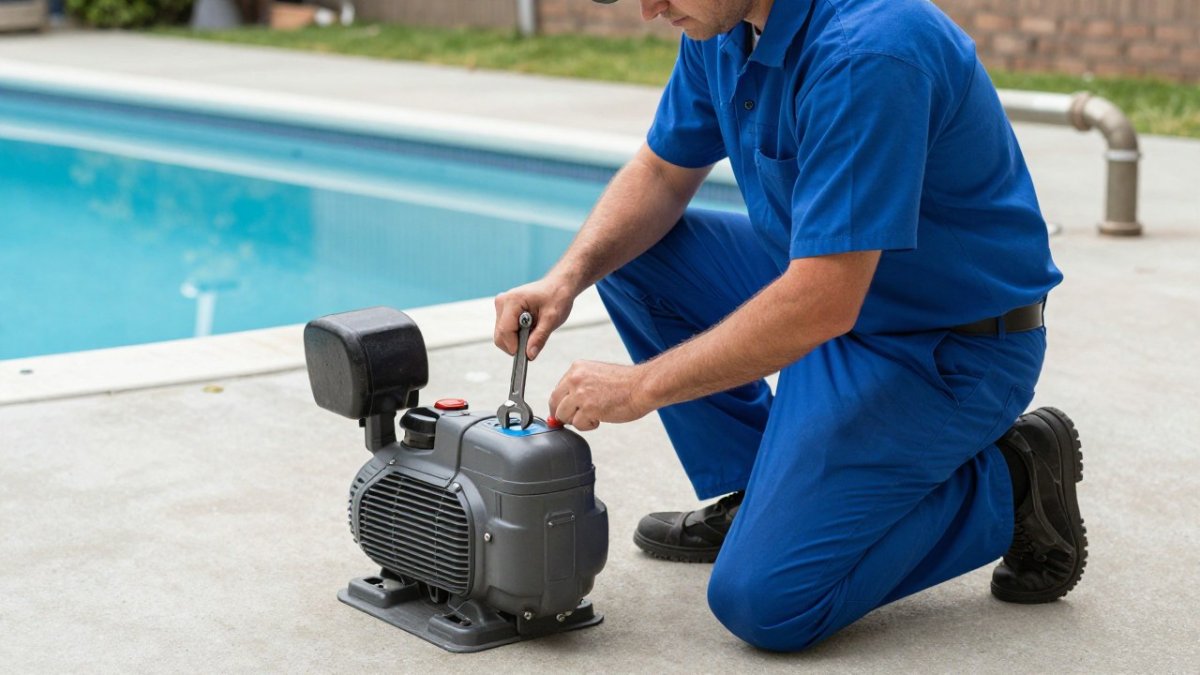
A grinding noise usually means a bearing is going. Left alone, it can seize the motor and take the whole pump with it. If your pump is on its way out, weigh the options with our pool pump repair vs replacement cost guide before you decide.
Water chemistry and circulation problems
Water that will not hold chlorine, constant pH swings, and scale on the tiles all point to chemistry trouble, but the root cause is often circulation, not the chemicals themselves. If water is not moving through the filter, chemicals cannot spread evenly, and you end up adding more product to fix a problem the pump and filter should be solving.
What poor circulation looks like
Check three things before you buy another bucket of chlorine. First, the filter: a cartridge or DE filter that has not been cleaned in months restricts flow, and a sand filter that has channeled lets debris straight back into the pool. Second, the skimmer: a clogged skimmer basket or a stuck weir door starves the pump and cuts surface cleaning. Third, the returns: if the jets are not pushing water across the whole pool, you get dead spots where algae settles and chlorine never reaches.
A common pattern is a pool that tests fine at the return but grows algae in the same corner every summer. That is a flow problem, not a chemistry problem. Adjust the return eyeballs to sweep toward the dead spot, and confirm the pump is moving water at its rated flow before you change your chemical routine.
Why chemistry will not stay balanced
High stabilizer (cyanuric acid) is the most common reason chlorine stops working. Once cyanuric acid climbs past roughly 70 to 80 ppm, chlorine is largely locked up and you can shock the pool repeatedly without clearing it. The fix is partial drain and refill, not more shock. The other frequent culprit is high total dissolved solids after a long season of top-offs, North Texas heat and evaporation concentrate everything in the water, so the pool you started with in May is not the same water by August.
pH swings usually trace to one of three things: aeration from a spa spillover or waterfall driving pH up, a sanitizer that shifts pH with each addition, or total alkalinity that is out of range and letting pH wander. Test alkalinity first, adjust it into range, then correct pH, doing it in the other order just means you will redo it. Our step-by-step guide to balancing pool chemicals safely walks through the order of adjustments.
When it is a repair, not a chemistry fix
If the filter is clean, the skimmer is clear, the returns are pushing water, and the chemistry still will not hold, the problem is mechanical: a failing pump impeller, a clogged suction line, a bad valve, or a filter that needs service. That is the point to stop buying chemicals and get the equipment checked. Persistent cloudy water, recurring algae within a week of shocking, and scale that returns after cleaning are the three signals that the fix is in the plumbing or equipment, not the water.
Pool repair vs. replacement: how to decide
Repair wins when the problem is isolated: one pump, one valve, one cracked fitting. Replacement makes more sense when the shell is failing, leaks are everywhere, or the equipment is old and failing piece by piece. Use this table as a starting point.
| Situation | Better Choice | Why |
|---|---|---|
| One failing pump or filter | Repair | Cost stays contained |
| Hairline surface cracks | Repair or resurface | Structure is sound |
| Widespread shell cracks | Replacement evaluation | Structural risk |
| Repeated leaks in multiple spots | Replacement evaluation | Chasing leaks gets costly |
| Equipment failing one item at a time | Replacement | Old systems compound |
When to DIY vs. call a pro for pool repair
Some checks are safe for any owner: the bucket test, skimming, brushing, and cleaning the pump basket. Others are not. Anything involving the pump motor, electrical connections, gas heaters, or structural cracks belongs with a licensed tech. If you are unsure, our team explains when to call a pool professional.
Schedule your pool inspection with Aqua Bright Pool Service
If two or more of these signs sound familiar, stop guessing and get a real diagnosis. Aqua Bright Pool Service has served the DFW area since 2006 with professionally trained technicians, a storefront office open to the public, and a randomized audit evaluation process for technicians.
A pool that loses water, runs loud, or fights every chemical adjustment is telling you something. Let our licensed team find the cause and fix it right the first time. Get started with Aqua Bright Pool Service and get your water back to clear, calm, and easy to maintain.
Frequently Asked Questions
What are common swimming pool repair issues?
The most common pool repair issues include leaks from cracked shells or plumbing, failing pumps and motors, clogged filters, broken valves, salt generator malfunctions, and surface deterioration such as scaling or worn plaster. Water chemistry imbalances often trigger secondary problems like algae growth and equipment corrosion. Catching these early with regular inspections prevents small fixes from becoming expensive replacements.
How can I tell if my pool is leaking?
Look for rapid water-level drops of more than 2 inches per week, wet spots or soggy soil around the pool deck, unexplained spikes in your water bill, and air bubbles in the pump basket. A bucket test can help distinguish evaporation from a leak. If the pool level drops faster than the bucket, call a professional for leak detection.
When should I call a professional to repair my pool pump?
Call a pro if you hear grinding or screeching noises, notice the pump shutting off repeatedly, see water leaking from the housing, or find that water is not circulating even after cleaning the filter basket. These are classic pool pump repair signs that often point to worn bearings, a failing motor, or a seal leak. Ignoring them can lead to total pump failure and higher energy bills.
Can cloudy pool water indicate an equipment problem?
Yes. Cloudy water often results from poor filtration, a clogged filter, a failing pump, or improper water chemistry. If shocking and balancing do not clear the water within 48 hours, the issue likely involves equipment or circulation. A professional inspection can pinpoint whether the filter, pump, or plumbing is the root cause.
